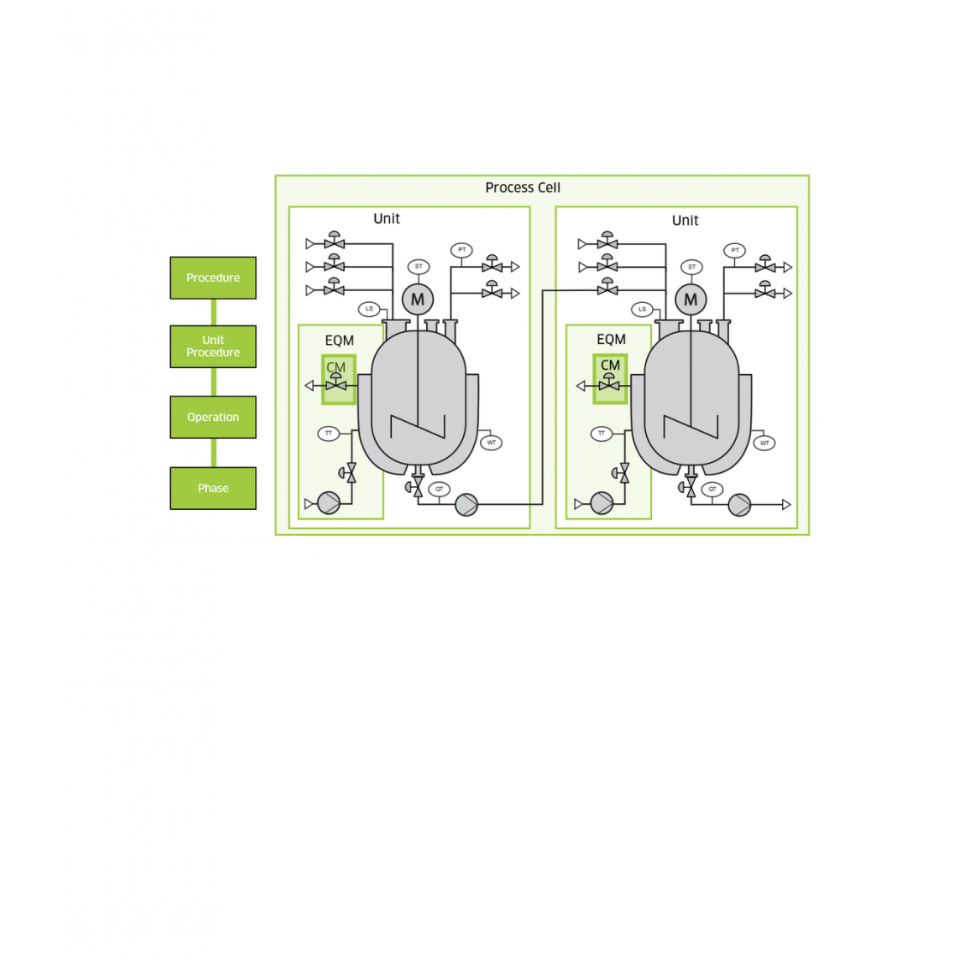
This is exactly where the joint project with a customer began. Sulzer Chemtech designed a test plant to support the transition from batch to continuous processes for applications in the pharmaceutical and fine chemicals industries. The plant is intended to provide the process data necessary for a safe and reliable scale-up. Therefore, in addition to plant control, a key component is the automated and structured collection of test data.
The goal of the project was to adapt the proven, modular software architecture used in production facilities to a laboratory system. Laboratory data was to be available in a format and with a structure similar to that of data from production-related facilities.
In line with the mini-plant concept, this means that even smaller laboratory skids with relatively simple equipment are not viewed as a single, loosely assembled unit, but are divided into functional modules and process units. Inputs and outputs are no longer simply numbered sequentially across the entire system, but are assigned to the respective modules. This makes it easier to retrieve information, evaluate it more effectively, and reuse it directly for subsequent scale-up steps.
In addition, the modular design also makes the overarching recipe and process control more transparent. The individual modules can be structured more clearly and integrated more easily into batch-compatible processes. This increases flexibility, making it easier to quickly adapt, expand, or recombine experimental procedures.