Data-Driven Process Optimisation AI
How much room for improvement is there in a process that has been running smoothly for years? This question was the starting point for a pilot project that CTE carried out in collaboration with Syngenta and Learning Machines at the Kaisten plant. The focus was on a dehydration column used to remove impurities through distillation. The goal was to operate the process more efficiently without compromising quality standards.

CTE has been working on the structured use of production data for many years. Although this data is available in large quantities, it is often not used to its full potential. This is precisely where the solution developed by CTE comes in Data Science Framework (DSF)What is the Data Science Framework (DSF)?CTE approach to AI-driven optimization of industrial processes based on real-world operational data. It combines a clear definition of objectives with systematic data screening and iterative analysis to gain reliable insights step by step and derive concrete opportunities for optimization. The first real-world pilot project with Syngenta focused on identifying additional optimization potential in a dewatering column and operating the process more efficiently without compromising quality standards.
Syngenta contributed its in-depth process expertise and defined the quality criteria to be met. CTE handled the data engineering and ensured that existing and newly acquired data were systematically collected, contextualized, and made available for analysis. Based on this data, Partner Learning Machines developed an AI model to optimize the column
Insights from AI
The project approach was deliberately designed to be iterative. At the outset, the existing data set was evaluated, and the team worked together to determine which changes to the existing process would be permissible as part of the optimization effort.
All relevant process data was obtained from the PI system, while the quality data was (still) transferred manually from the LIMS. CTE prepared the data in the required format and made it available for modeling. This created exactly the data foundation needed to develop an effective optimization model from complex process data.
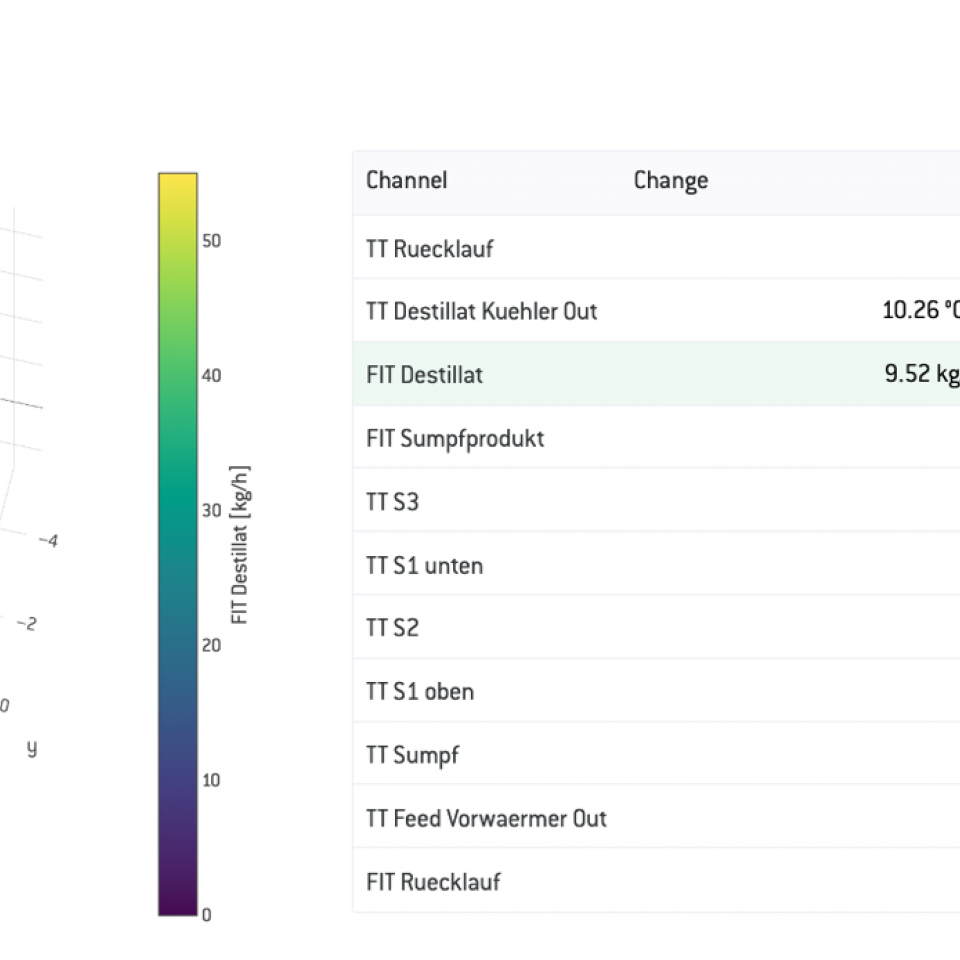
During an intensive five-week testing phase, targeted test series were conducted during normal operations. The AI model calculated uncertainties and iteratively suggested only those parameter settings for each trial that offered the greatest potential for improvement with minimal risk. The actual results were continuously fed back into the optimization process via the data pipeline established by CTE. Through regular communication with the process experts, the results were jointly interpreted and actions derived. This created a continuous learning process for all involved.
This revealed a significant difference between traditional physical analysis approaches and data-driven models. While physical models describe relationships in a thermodynamically consistent manner, they inevitably rely on simplifications. Data-driven models, on the other hand, capture the actual behavior of the system and can also model complex interactions between parameters. This reveals relationships that were previously unknown and, consequently, could not be utilized in practice.
"Based on the insights gained
, the approach is now being further developed
."