Cookies

This website uses cookies that require your consent.

Skip to content

"We are well positioned for a cross-divisional project"

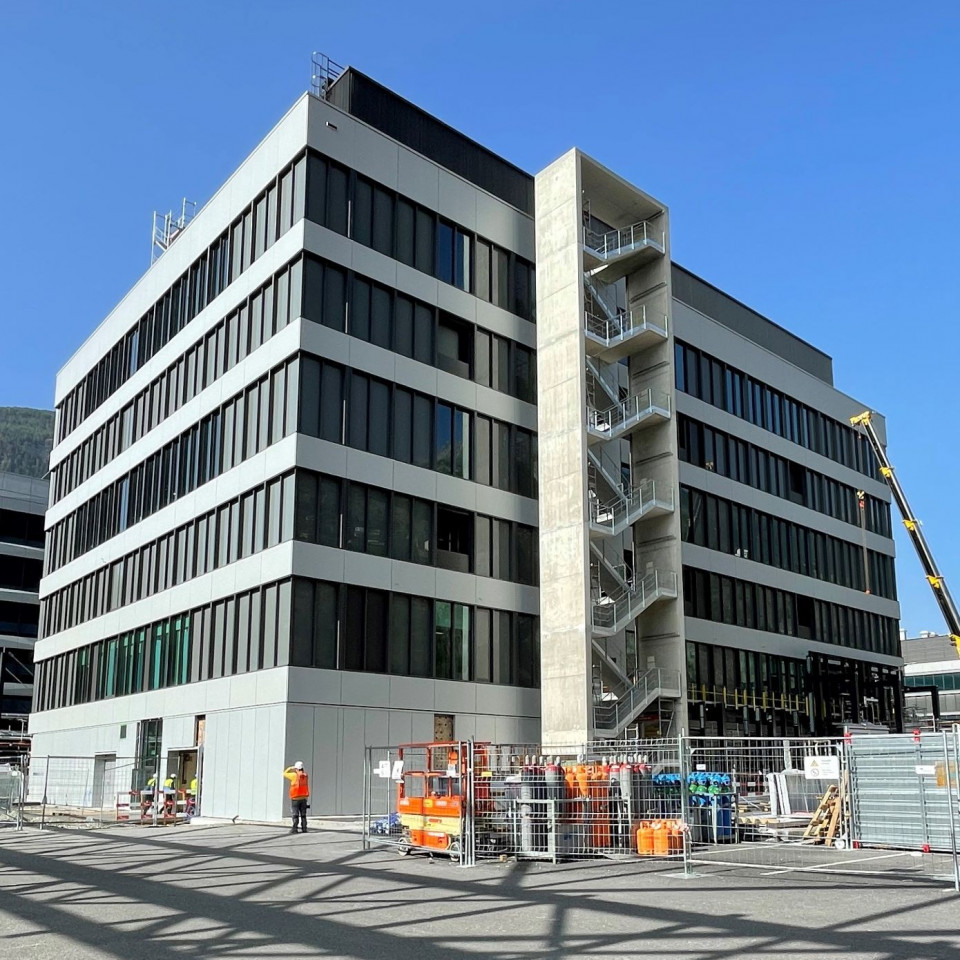
With around 4,700 hours of work, 20 employees involved from the fields of automation, industrial and office IT and the in-depth expertise of overall project manager Raffael Hänggi, the major Bacthera project has shown that it's not only our customers that benefit from the one-stop solution. Raffael Hänggi explains why.

Raffi, this was your first major cross-divisional project, what was your experience?

Raffi Hänggi: When we received the contract from Bacthera to implement an IT/OT infrastructure and a production DCS, it was clear that we would need to assemble a team of experts with diverse skill sets. Thanks to our matrix organization, I was able to identify the optimal team for the project based on the client’s requirements.

A total of 20 employees from various departments with specialized expertise were involved. The collaboration worked very well, and we engaged in active dialogue with one another.

The project demonstrated that we are well-positioned to handle cross-functional projects. Not only were we able to learn from one another internally, but the client also benefited.

What are the specific benefits for our customer?

Raffi Hänggi: Thanks to our one-stop solution, we were more efficient overall because there were so few interfaces. When problems arose, we had short internal communication channels and could more easily resolve them ourselves with the help of the various experts on the team. Another advantage was our clearly defined internal communication channels. As a general rule, we always tried to be represented by a single point of contact (SPOC) in higher-level meetings.

Through centralized progress tracking, all internal work streams could be displayed at a glance and made available to the client in a report.

But surely there are also challenges to overcome in a major project?

Raffi Hänggi: The biggest challenge was the tight timeline. For one thing, we had to deal with hardware delivery issues. For another, we had to organize a significant amount of manpower within two months. Right from the start, 10 employees were involved and working full steam ahead on the project.

In addition, cross-functional collaboration in itself presents challenges. Coordination had to be carefully managed, as the automation and IT teams were addressing different issues and challenges in parallel. There were also various factors from other disciplines that were, in some cases, very difficult to anticipate but which had a major impact on the schedule and costs. As the overall project manager, wearing all those hats at once was certainly the biggest challenge.
Professional internal controlling is the most important tool for such a large project.
Raffael Hänggi, automation expert and overall project manager

So, do you also consider the project a success from a CTE perspective?

Raffi Hänggi: Absolutely, because we achieved our goal and delivered the required equipment on time. Despite the short notice, we were able to design and install a fully functional infrastructure for Bacthera by the deadline.

What have we learned in view of future projects?

Raffi Hänggi: Professional internal controlling is the most important tool for a project of this size. It allowed us to keep deadlines and costs under control at all times. Going forward, we want to carry out more projects under one roof. I’m convinced that we’re well-positioned to do so.
Photo of Raffael Hänggi, Head of Automation
at ControlTech Engineering AG.

Are you interested in a similar project?

Schedule a no-obligation consultation with Raffael Hänggi, Head of Automation.

Contact us now